
Why Does Gel Burn in the Lamp? Understanding Polymerization, Heat Generation and Proper Gel Nail Curing
“Ouch, that burns! Did I do something wrong?”
If you have ever had gel nails applied or cure your own gel nails at home, chances are you have heard—or even said—this sentence before. The sensation of heat during curing in a UV/LED lamp often surprises beginners, but even experienced salon clients can experience it.
The good news is that, in most cases, it is not caused by faulty products, a poor-quality UV/LED lamp or inferior gel. It is a completely natural physical and chemical process that occurs when light-curing gel products harden. Professional nail technicians are familiar with this phenomenon, but if you are new to gel nail enhancements, let's take a closer look at why gel sometimes burns during curing and when this reaction is perfectly normal.
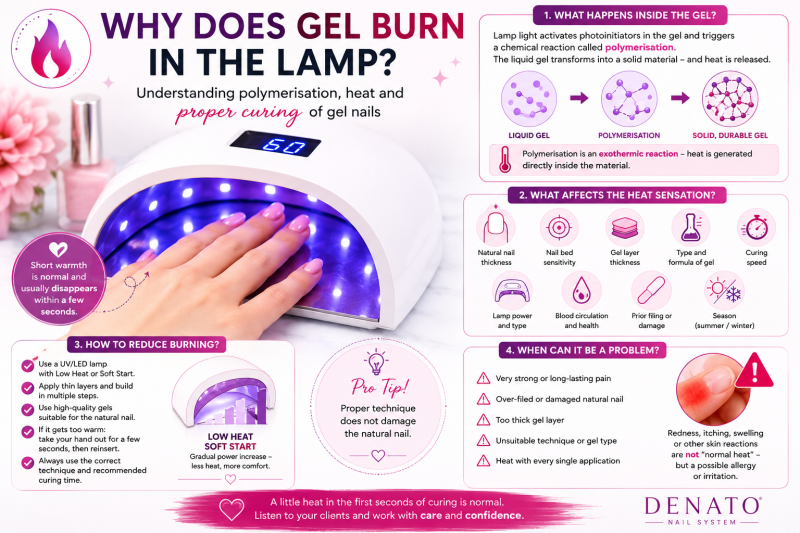
What Happens Inside the Gel During Curing?
Gel is not a "dry" material. Until it is placed under a UV or LED lamp, it remains liquid or semi-liquid. As soon as the light activates the photoinitiators contained in the gel, a chemical reaction called polymerization begins.
During polymerization, individual molecules link together to form a solid structure. Within seconds, the liquid gel transforms into a durable, rigid material that maintains its shape and forms the foundation of a professional gel nail enhancement.
And it is precisely during this reaction that heat is generated.
The lamp itself is not heating the nail in the same way as a hairdryer. Instead, the heat is produced directly inside the gel while it cures. Polymerization is an exothermic reaction, meaning it naturally releases heat. This is not a defect but an inherent characteristic of all light-curing gel systems.
A heat spike is not a burn injury. It is simply a temporary increase in temperature during rapid gel polymerization. In most cases, it lasts only a few seconds and, when proper application techniques are used, does not damage the natural nail.
Why Do Some Clients Feel Nothing While Others Experience Burning?
Every natural nail is different. The same gel, the same lamp and the same application technique may produce no sensation at all for one client, while another may experience a stronger feeling of heat for several seconds.
The intensity of the sensation depends on several factors:
- the thickness of the natural nail,
- the sensitivity of the nail bed,
- the amount of product applied,
- the type of gel used,
- the speed of polymerization,
- the lamp's output and technology,
- the condition of the natural nail,
- previous filing or mechanical damage to the nail,
- current blood circulation and skin sensitivity.
Some clients feel absolutely nothing, while others notice a more intense heat sensation for a few seconds. Both situations are completely normal. The intensity of the heat alone does not indicate the quality of the gel or the quality of the curing process.
Why Is the Sensation Usually Stronger in Summer Than in Winter?
You may have noticed that curing often goes almost unnoticed during colder months, whereas on hot summer days the heat can feel much more intense. This is no coincidence.
During summer, the body is naturally better supplied with blood. Higher ambient temperatures cause blood vessels to dilate as the body tries to dissipate excess heat. Better circulation makes nerve endings more sensitive, allowing them to perceive the heat generated during polymerization more intensely.
The temperature of the product itself also plays a role. Gel stored or used in a warmer environment generally has a thinner consistency and behaves differently than gel used in cooler conditions. Higher salon temperatures, warmer hands and warmer gel can all contribute to making the exact same application technique feel more intense in summer than in winter.
As a result, the same product, the same UV/LED lamp and the same curing technique may feel almost unnoticeable during winter, while the client experiences a noticeable heat sensation for several seconds during hot summer weather. In most cases, this is still a completely normal part of the curing process.
The Thicker the Gel Layer, the More Heat Is Generated
Polymerization occurs throughout the entire volume of the material. If the gel is applied in a very thick layer, the reaction becomes more intense and releases more heat at once.
This is why the strongest heat sensation is most commonly experienced when working with builder gels, creating a larger apex or repairing broken nails, where a greater amount of product is applied. Thin layers, such as those used with certain coloured gel polishes, generally produce significantly less heat.
For this reason, experienced nail technicians build the nail gradually, work with an appropriate amount of product and apply techniques that help minimise heat generation whenever necessary.
Why Do Some Gels Burn More Than Others?
Different UV/LED gels vary in formulation, viscosity, reactivity and the type of photoinitiators they contain. Some products are designed for extremely fast curing, while others polymerize more gradually.
As a result, two high-quality gels can produce different levels of heat without reflecting their quality. A gel that generates more heat is not necessarily inferior, just as a gel that produces little or no heat is not automatically better cured.
The most important factors are compatibility between the gel and the lamp, the correct product thickness, the recommended curing time and proper professional application techniques.
The Lamp Also Makes a Difference
Modern LED lamps offer high output and cure products very quickly. This is beneficial because treatments become faster and curing is generally more reliable. However, the polymerization process may also become more intense than with older UV lamps.
For this reason, many UV/LED lamps feature a Low Heat or Soft Start mode. In this setting, the lamp gradually increases its power output, allowing polymerization to progress more slowly and significantly reducing the heat spike experienced by the client.
The Low Heat mode is particularly useful when working with builder gels, long nail enhancements, repairs or clients with especially sensitive nail beds.
When Is the Burning Sensation During Gel Curing Normal?
A brief feeling of warmth or a burning sensation during the first few seconds of curing is completely normal. In most cases, it disappears on its own within a few seconds and does not indicate any problem.
If the sensation becomes too intense, simply remove the hand from the lamp for a moment and place it back inside after a few seconds. This slows down the polymerization process, allowing the gel to continue curing comfortably.
A client should never be expected to "just endure the pain." Professional nail services are about controlling the material, the lamp, the product thickness and the client's comfort throughout the entire treatment.
When Can the Burning Sensation Indicate a Problem?
Excessive or repeated burning may indicate:
- a natural nail that is too thin or mechanically damaged,
- an over-filed nail plate,
- an excessively thick layer of product,
- incorrect application technique,
- using a gel that is not suitable for the specific nail type,
- curing too quickly without using the Low Heat mode.
However, the burning sensation itself does not automatically mean an allergy or poor-quality gel. If redness, itching, swelling, burning of the skin, weeping or any other skin reactions appear after curing, the nail enhancement should be evaluated and the cause should be investigated beyond the temporary heat sensation alone.
The warmth experienced during curing is simply the thermal effect of polymerization. An allergic reaction usually presents differently, for example with itching, redness, swelling or irritation of the skin surrounding the nail.
Can the Burning Sensation Be Reduced?
Yes. Several simple professional practices can significantly reduce heat generation during curing:
- use a high-quality UV/LED lamp with a Low Heat or Soft Start mode,
- avoid applying unnecessarily thick layers of product,
- build larger enhancements using multiple thin layers instead of one thick layer,
- do not remove the inhibition layer between coats unless the product instructions specifically require it,
- select the appropriate gel according to the condition of the natural nail,
- for larger nail extensions, consider using polygel, which allows more precise sculpting and often produces a more comfortable curing experience due to its application method,
- if excessive heat occurs, briefly remove the hand from the lamp,
- avoid over-filing the natural nail,
- use suitable nail files, electric nail files and gentle preparation techniques,
- for weakened nails, include appropriate natural nail care.
For clients with particularly sensitive or weakened natural nails, it is advisable to work more gently, apply smaller amounts of product at a time and carefully monitor their comfort throughout the curing process.
What to Do If the Gel Feels Too Hot During Curing
If the client experiences an intense heat sensation, there is no need to panic. The important thing is to respond calmly and systematically.
- The client briefly removes the hand from the lamp.
- After a few seconds, once the heat has subsided, the hand is placed back into the lamp.
- Complete the curing process according to the manufacturer's recommended curing time.
- For the next layer, apply a smaller amount of gel or switch to the Low Heat mode.
Avoid moving the hand around inside the lamp during curing. It is much better to briefly remove it and then return it to the correct position so that polymerization can continue evenly.
Do Not Store UV Gels in the Refrigerator or Freezer
It may seem logical to cool your gel during hot summer weather, but the opposite is actually true. UV-curable products are formulated to be stored at a stable room temperature. Rapid cooling followed by warming creates thermal shock, which can affect the product's consistency, homogeneity and workability.
Some products may separate or experience changes in viscosity, affecting both application and final performance. For this reason, gels should never be stored in a refrigerator or freezer.
Long-term storage at low temperatures is generally unsuitable for most UV products because it may alter their consistency. Exposure to warmer temperatures followed by gradual adaptation to room temperature is usually much less harmful than sudden temperature changes.
For better understanding, some gels are intentionally warmed during manufacturing or filling processes to reduce viscosity and improve handling. This also explains why certain gels become thinner during hot summer days.
Maintain a Stable Temperature in Your Working Environment
The ideal working temperature is approximately 20–25 °C (68–77 °F). Once the room temperature exceeds 30 °C (86 °F), not only does working become less comfortable, but the properties of certain products can also begin to change.
If air conditioning is not available, regular ventilation or a high-quality dust extractor can help. For example, the Tajfun dust extractor generates strong airflow that improves air circulation around the workstation, making the working environment more comfortable. It helps reduce the perceived temperature in the salon, and the airflow beneath the table is especially pleasant during hot summer days for both the nail technician and the client.
Today, affordable portable air conditioning units are also widely available and can significantly improve the salon environment. Maintaining a stable temperature is not only about comfort—it also provides better control over the behaviour of professional nail products.
Store Your Products at a Stable Temperature
The greatest enemy of UV-curable products is not summer heat itself, but frequent temperature fluctuations.
Never leave gels in direct sunlight, inside a hot car or on a windowsill. The ideal storage place is a dry location away from UV light at a stable room temperature.
- If you regularly transport products between salons or training sessions, an insulated storage box or thermal bag can help minimise sudden temperature changes during transport.
- If you have access to a wine cooler that maintains a stable temperature of around 20 °C (68 °F), it can be an excellent place to store selected products away from light.
- Always protect your products from direct UV exposure, as light may begin affecting their stability even before they are used.
Shipping Products During Summer and Winter
During summer, high temperatures are not only an issue while working—they also affect transportation. Parcels may spend several hours inside overheated delivery vehicles or parcel lockers where temperatures can become significantly higher than the outside air.
For this reason, do not leave your products in direct sunlight after delivery, even if they are still inside the parcel. Once received, place them in a stable environment and allow them to acclimatise naturally to room temperature before use.
Winter presents the opposite situation. After transportation, products may become thicker, especially if they have been exposed to low temperatures for an extended period. Even then, they should never be heated rapidly. Allow them to return to room temperature naturally over several hours.
Do not open or use your products immediately after delivery if they have been exposed to extremely high or low temperatures. Always allow them to acclimatise to room temperature first.
Common Myths About Gel Burning in the Lamp
- Myth: If the gel burns, it must be poor quality.
Reality: The heat sensation is mainly influenced by the speed of polymerization, the amount of product applied, the condition of the natural nail and the client's individual sensitivity. - Myth: If the gel does not burn, it is always cured better.
Reality: The amount of heat generated does not indicate curing quality. Following the recommended curing time, using the correct lamp and applying the proper layer thickness are what truly matter. - Myth: Burning means an allergy.
Reality: The temporary heat generated during polymerization is not an allergic reaction. Allergies usually present with symptoms such as itching, redness or swelling. - Myth: The client simply has to tolerate the burning sensation.
Reality: If excessive heat occurs, the correct procedure is to briefly remove the hand from the lamp and then continue curing once the sensation subsides.
FAQ: Frequently Asked Questions About Gel Burning During Curing
Why does gel burn in a UV or LED lamp?
Gel feels hot because of polymerization. During this chemical reaction, the liquid product transforms into a solid structure while releasing heat. This thermal effect is completely normal for light-curing gel systems.
Is it normal for gel to burn during curing?
Yes. A brief feeling of warmth or burning during the first few seconds of curing is normal. However, if the sensation becomes extremely intense, repeatedly painful or lasts longer than expected, the amount of product, curing mode and condition of the natural nail should be assessed.
Can the heat damage the natural nail?
A short-lived heat spike during a correctly performed gel application does not normally damage the natural nail. The risk increases mainly when the nail has been over-filed, excessively thinned, weakened or covered with an overly thick layer of product.
Does the Low Heat mode reduce burning?
Yes. Low Heat or Soft Start mode gradually increases the lamp's output, allowing polymerization to occur more slowly. This significantly reduces the heat spike and makes curing much more comfortable for the client.
Why does builder gel usually feel hotter than gel polish?
Builder gel is typically applied in a much greater volume than coloured gel polish. The more product that polymerizes at one time, the more heat is released. This is why builder gels usually generate a stronger heat sensation.
Conclusion: A Heat Spike Is Not a Reason to Panic—It's a Signal to Review Your Technique
In most cases, the sensation of heat during gel curing is a completely natural part of the polymerization process. It does not automatically mean there is a problem with the product, the lamp or the nail technician's work.
The key is to distinguish between a temporary heat spike that disappears within seconds and genuine issues such as an over-filed natural nail, excessively thick product application or skin reactions around the nail.
Once you understand why the heat occurs, there is no reason to fear it. It is simply part of the process that transforms liquid gel into a durable, long-lasting nail enhancement within moments.
Wishing you a wonderful summer season and comfortable, enjoyable work in your nail salon.
Article Author
This article was prepared by Lucie Králová and the DENATO professional team based on extensive experience from professional nail salon practice.
Last Updated
This article has been updated according to the latest professional knowledge and best practices in the nail industry.