
DENATO Builder Gels: How to Navigate Material Strength
How to understand the strength of builder gels and choose the right material based on the natural nail type.
Over the years of working in the salon, I have confirmed one simple thing many times – there is no single gel that is ideal for all nails. Every natural nail is different. It varies in strength, flexibility, thickness and in how it reacts to the material.
Today’s range of builder gels includes many variations – from highly flexible to extremely rigid construction gels. For both beginner and experienced nail technicians, it can sometimes be difficult to navigate them quickly. To simplify my work, I developed a simple guide – a material strength scale (1–10).
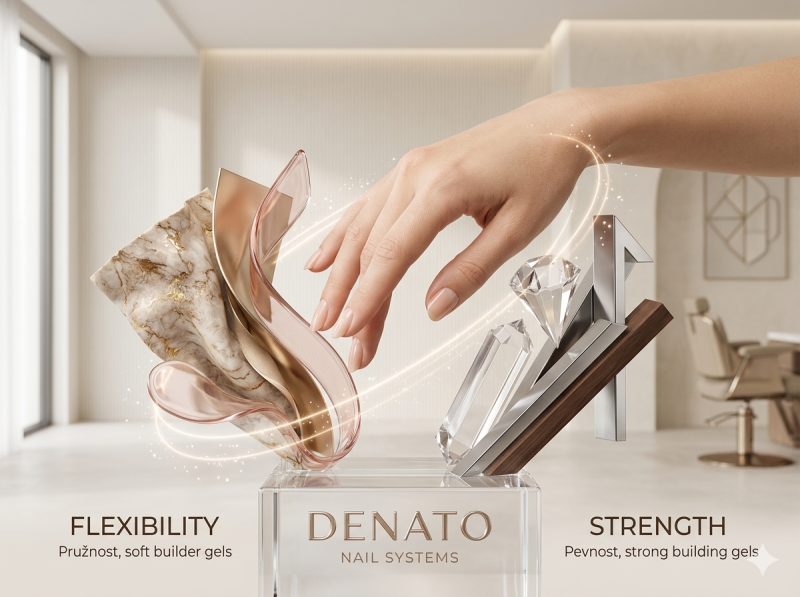
Each product is assigned a strength number. However, it is important to understand that this is only a guideline – every nail is individual, and even the chosen base can change how the builder gel behaves and the overall properties of the enhancement. For example, UB Base Gel can increase the strength of the structure by approximately half a level, while Sculpting Gel can make it more flexible by approximately one level.
Logic of the entire scale
- 1–3 → highly flexible materials: adapt to the natural nail movement, suitable for thin or damaged nails, and also ideal as a base layer under rigid gels.
- 4–5 → flexible builder gels: still work with the nail, suitable for natural-looking enhancements and as a base under stronger materials.
- 6–7 → strengthening systems: stabilise soft nails, combine flexibility with strength, and can support short extensions on forms.
- 8–10 → rigid construction gels: maintain structure, suitable for longer enhancements, pinching, and working with forms.
Classification by strength scale
1–3 | Flexible materials
- Sculpting Gel 1
- Rubber Base Clear 1.5
- Crystal Clear 2
- Rubber Base Milky Rosé 3
Adapt to the movement of the natural nail. Suitable for thin or damaged nails and as a base layer.
View flexible gels →4–5 | Medium flexibility
- Rubber Base Cover Rosé 4
- Rubber Base Milky White / Skinny 5
- Master Soft Clear 5
Flexible builder gels suitable for natural enhancements and as a base under stronger materials.
View Rubber bases →6–7 | Strengthening systems
- Nail Strength Coat 6
- Polyacryl Base 6
- Soak Off Builder 6–7
- Monophase Soft 7
Stabilise soft nails. A combination of flexibility and strength that supports short extensions.
View strengthening gels →8–10 | Construction gels
- Monophase (Basic line) 8
- Fluffy Gel 8
- Camouflage Cover Natur 8
- Monophase Plus 8.5
- Power Gel / Polygels 8.5–9
- Exclusive Builder Clear 9
- Acrylic 10
Maintain structure. Suitable for longer enhancements, forms, and pinching.
View strong gels →The flexibility or rigidity of the material must always be selected according to the natural nail type. There is no universal gel that will suit all nails equally.
Monophase gel classification
The individual MONOPHASE lines are based on the same technology but differ in their strength and behaviour during application. Therefore, they are positioned within the scale according to their approximate strength.
- 7 → Soft: more flexible builder gel (moves more with the nail)
- 7.5 → Builder: bottle builder gel (more stable but still flexible)
- 8 → Basic line: classic builder gel (standard rigid construction)
- 8.5 → Plus: stronger version suitable even for extreme lengths
How to navigate the DENATO range
We have been on the market for more than 15 years, and our products naturally fall into three logical groups:
Core products
Products such as Fluffy, Exclusive Builder, Crystal Clear, Camouflage Cover Natur and the basic Monophase line form the backbone of our brand. These are gels used consistently in everyday salon work.
Typically, these include:
- a rigid builder gel for construction,
- a more flexible gel for natural nails,
- a “universal” modelling gel.
These gels have been used in salons for many years. They are only minimally adjusted (for example due to EU regulations), and we always ensure that their key properties remain unchanged.
Specialised products
Products developed based on real salon needs:
- strengthening weak nails,
- pinching,
- extreme lengths,
- pedicure.
For example, the Master range is mainly used by more experienced technicians due to its thixotropic properties. The new Polygels have been redesigned and expanded with more shades.
Effect ranges
Milky, glitter, camouflage and various shades bring visual variety to the salon.
- clients enjoy discovering new looks,
- salons benefit from visual diversity.
These gels often share the same construction base you are already familiar with – the difference is mainly in colour and slightly in strength.
For example: Monophase clear, milky and rosa all have the same strength level 8 – the structure remains identical, only the visual effect changes.
How to decide when working with problematic nails
1. Assess the nail condition: Observe thickness, flexibility, possible damage, lifting or splitting. For weakened nails, I often recommend the IBX system, which strengthens the nail from within before enhancement.
IBX works inside the nail plate, helping to improve the structure of the natural nail before any product is applied.
2. Client’s expectation: It is also important to understand what the client wants – to maintain the natural nail, to strengthen it, or to extend it.
3. Material selection: Only then comes the system choice:
- natural nail → more flexible materials,
- weakened nail → strengthening base or IBX,
- extensions → stronger builder gel.
Every nail reacts differently, so it is always necessary to choose an individual combination of materials, including the base.
This mindset will naturally reflect in the quality of your work. I also recommend reading the article about Base, where this topic is explained in more detail.
FAQ: Frequently asked questions
How do I recognise that I have chosen a gel that is too rigid?
It usually shows by cracking on soft nails, lifting, or the client feeling pressure within the structure.
Can the base influence the final behaviour of the enhancement?
Yes. Even a correctly selected builder gel can behave differently depending on the base used underneath. UB Base can slightly increase rigidity, while Sculpting Gel makes the structure more flexible.
When should I choose a more flexible material?
Flexible materials are ideal for thin, soft or damaged natural nails and also as a base under stronger construction gels.
When is a rigid builder gel the better choice?
Whenever you need to maintain structure, create longer extensions, work with forms or perform pinching, a more rigid builder gel is the better option.
Does an effect shade have a different structural function than the clear version?
Not necessarily. In many cases, it is based on the same gel formula, with differences mainly in colour and slight variations in strength. It is always important to follow the specific product line and its position within the scale.
I wish you many satisfied clients, minimal lifting, and maximum durability of your enhancements!
This article was prepared by Lucie Králová in cooperation with the DENATO expert team, based on many years of salon experience.