
Why UV/LED top coat hardens in the bottle and how to prevent it
You open a bottle of top coat and notice that the material is becoming thicker, forming strings or leaving small hardened particles on the brush. Yet you have not placed it inside the curing lamp. The cause may be light falling on the open bottle during normal work.
UV/LED materials have been changing in recent years alongside technology and European legislation. This means that even a product you have used for many years may begin to behave differently. Let us look at how premature polymerisation occurs, which light sources may play a role and how to arrange your workspace so that the material remains stable.
Imagine that you have been working with UV/LED materials for fifteen or twenty years. You know their consistency, curing time and the correct way to handle them. When a familiar top coat suddenly starts behaving differently during use, it is natural to ask whether the working method, the salon environment or the material itself has changed.
The answer may not be simple. A change to a single ingredient can affect not only curing time but also storage stability, sensitivity to ambient light and application properties. However, the same symptom may have another cause. It is therefore important not to judge a product solely by the first impression.
When a familiar material starts behaving differently
A gel becoming thicker does not automatically mean there is a manufacturing defect or an application error. Viscosity is affected by temperature, storage and formulation stability. However, if the gel forms strings, solid particles appear on the brush or deposits develop mainly around the neck of the bottle, light exposure should also be investigated.
It is important to distinguish between a temporary change in viscosity and actual polymerisation. A cold material may be thicker, and its consistency can return to normal once it reaches the recommended temperature. Partially cured particles, however, cannot be returned to their original state simply by stirring or warming the product.
How UV/LED gels cure
UV/LED gels contain reactive ingredients and photoinitiators. A photoinitiator absorbs light within a suitable wavelength range and produces reactive species that initiate polymerisation. In common acrylate- and methacrylate-based nail materials, this is generally free-radical polymerisation.
A photoinitiator does not distinguish whether the light comes from a professional UV/LED lamp, the sun or another source. What matters is the overlap between the emission spectrum of the source and the absorption spectrum of the photoinitiator, together with light intensity and exposure time. The result is also affected by photoinitiator concentration, pigmentation, layer thickness and the other ingredients in the formulation.
As long as the photoinitiator is not exposed to light that it can absorb effectively, the material should remain workable. Once enough energy has been absorbed, reactive species are created and the individual ingredients begin to link together into a solid polymer network. Inside the curing lamp, this process is desirable. Inside an open bottle, it causes irreversible damage to the material.
Why the wavelengths 365 and 405 nm matter
Professional curing lamps often combine diodes operating around 365 and 405 nm. A wavelength of 365 nm is within the UVA range. A wavelength of 405 nm is generally classified as visible violet light, although the boundary between ultraviolet and visible light is not perfectly sharp.
Some photoinitiators absorb mainly in the UVA range, while others also absorb in the visible violet or blue part of the spectrum. The sensitivity of a material therefore cannot be predicted solely from the terms UV or LED.
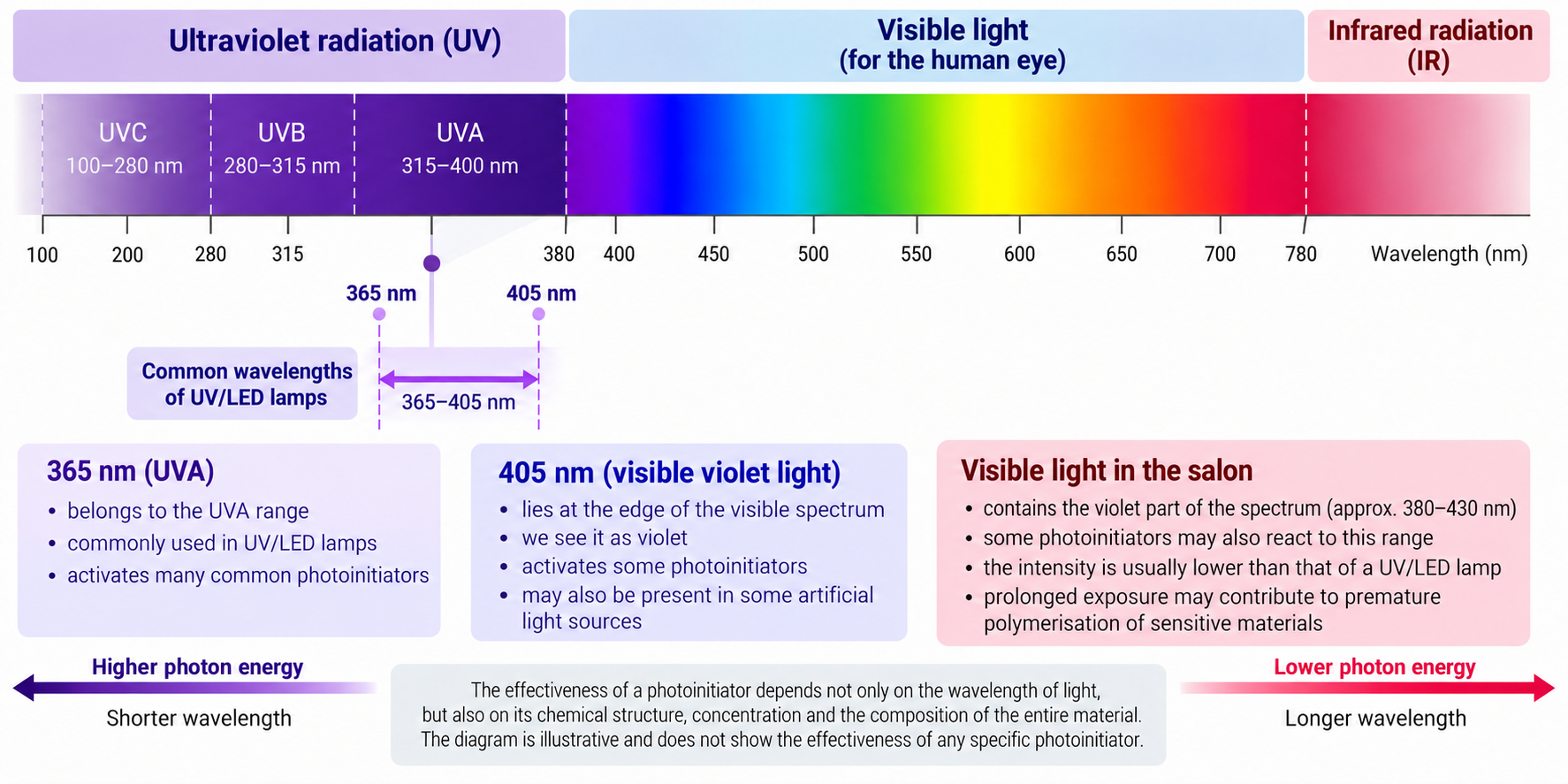
Daylight has an effect even in winter and behind glass
UV radiation does not disappear when the sky is cloudy or summer ends. Its intensity varies according to the season, time of day, cloud cover, geographical location and other conditions, but some radiation reaches the Earth's surface even in winter and under overcast skies.
The type of glazing also matters. Ordinary clear glass usually blocks virtually all UVB radiation, but it may transmit a significant proportion of UVA. Laminated, tinted or specially treated glass may reduce UVA much more effectively. It is therefore unsafe to rely solely on the fact that there is a window between the worktable and the sun.
If you work near a window, observe where the light falls during the day. Blinds, shades or repositioning the open bottle can significantly reduce exposure.
Can gel also react to a desk lamp?
Yes, this is possible with a sensitive material, but it does not mean that every LED or fluorescent lamp will cause a problem. The actual spectrum, intensity, distance, direction of the light and exposure time are what matter.
Some work lamps emit light in the short-wavelength visible range, which may overlap with the absorption spectrum of a particular photoinitiator. The risk is usually lower than with a curing lamp, but an open bottle or illuminated brush may be exposed repeatedly and for extended periods. If the manufacturer warns of increased sensitivity, do not aim the desk lamp directly at the neck of the bottle.
Why two gels can behave differently in the same salon
Every material has its own photoinitiator system and formulation. Individual photoinitiators differ in their absorption spectra and in how efficiently they create reactive species. Their concentration, combination with other ingredients, pigmentation and the material's light transmission also create differences.
Various types of photoinitiators are used, or have historically been used, in nail materials. These include acylphosphine oxides such as TPO, TPO-L and BAPO. Their names alone are not sufficient to predict how the finished product will behave. The specific amount, the combination of initiators and their interaction with oligomers, monomers, pigments and stabilising ingredients are all important.
Faster curing inside a lamp therefore does not automatically mean greater sensitivity under normal salon lighting. Nor can it be generally claimed that every gel without a particular photoinitiator will be more sensitive. Its behaviour is the result of the entire formulation and must be assessed for the specific product.
Older generations of materials took two to three minutes to cure in some UV lamps. Manufacturers often specify substantially shorter times for current products. However, curing speed is not determined by the photoinitiator alone. It is also affected by the lamp's spectrum and actual output, the distance between the material and the diodes, the thickness of the applied layer, the shade, pigmentation and the transmission of light through the material.
This is why it is important to follow the manufacturer's current instructions even for a type of product that you have used for many years. Experience matters, but it cannot replace information about the specific formulation and recommended lamp.
What the ban on TPO in cosmetic products changed
Since 1 September 2025, the use of Trimethylbenzoyl Diphenylphosphine Oxide, known as TPO, in cosmetic products has been prohibited in the European Union. The change was established by Commission Regulation (EU) 2025/877 following the classification of TPO as a category 1B substance toxic to reproduction.
Manufacturers of products containing TPO had to adjust their formulations. Replacing a photoinitiator, however, is not simply a matter of exchanging one raw material for another. The new system must provide correct curing, stability, adhesion, mechanical properties and appearance. Application properties or sensitivity to ambient light may therefore change after reformulation. This is not, however, an automatic rule for all TPO-free materials.
What happens inside an open bottle
If suitable wavelengths of light reach the material, polymerisation may begin in the areas receiving the most light. These are typically the material on the brush, around the neck or immediately below the bottle opening. The opaque packaging protects most of the contents, but the open area remains exposed.
The reaction may not be immediate or visible at first. Initially, it may take place only in a small illuminated part of the material. Repeated brief exposure during each service can gradually accumulate until the change becomes apparent through altered consistency or the formation of solid particles.
The first signs may be subtle:
- the gel becomes thicker or forms strings,
- gel-like or solid particles appear on the brush,
- deposits form around the neck of the bottle,
- the material no longer levels evenly.
Do not return damaged particles to the bottle with the brush. If you are uncertain about the cause or condition of the product, stop using it and contact the supplier.
Brilliant Gloss 1484 as an example from DENATO practice
In practice, we have observed pronounced sensitivity to ambient light with the no-wipe top coat Brilliant Gloss 1484. We therefore highlight this directly in the product description and recommend turning the desk lamp away during application, avoiding direct light on the brush or into the open bottle, and closing the product immediately after use. The current formulation does not contain TPO.
Brilliant Gloss was already more sensitive than some other wipe and no-wipe top coats. Following adjustments to the formulation, however, we have found that even greater attention must be paid to lighting conditions and the handling of the open bottle.
When used correctly, the top coat performs as intended, but it requires consistent handling. In addition to the warning in the product description, we have therefore introduced inspection of individual products before dispatch. Experience shows that even a professional nail technician can be surprised by a change in the behaviour of a familiar material. This is not necessarily due to a lack of experience; sometimes a product property to which the technician was accustomed has genuinely changed.
This experience demonstrates why it is important to read the current instructions even for a familiar product. A temporal connection between a formulation change and different material behaviour does not by itself prove that one replaced ingredient was the cause. The entire system is always decisive.
How to prevent premature polymerisation
- Check the daylight. Observe your worktable at different times of the day and use blinds or shades when necessary, or move open products to a more protected position.
- Turn the work lamp away. Do not aim it directly into the open bottle or at a brush carrying the material.
- Keep bottles away from the curing lamp. Remember that light can also escape from the sides.
- Open the product only for as long as necessary. Clean the bottle neck as recommended by the manufacturer and close the bottle immediately after application.
- Follow the storage conditions. Protect the material from sunlight, heat and significant temperature fluctuations.
- Follow the specific instructions. Curing time, the appropriate lamp and conditions of use may vary between products.
For the final layer, choose a top coat according to the properties you require and always follow the instructions provided for the specific product.
Why the packaging and amount of light matter
The same material may not react in the same way inside a transparent jar, on a brush and inside an opaque bottle. What matters is how much light actually reaches each part of the gel. A thin layer on the brush is exposed to light from several directions, while most of the contents are protected by the opaque packaging and the mass of the material itself.
Polymerisation may therefore begin on the brush or around the neck while the gel deeper inside the bottle remains liquid. If the particles that have formed are returned to the packaging on the brush, they may contaminate the remaining contents and make the product more difficult to apply.
The most common mistakes in salon practice
- leaving an open bottle under the desk lamp throughout the service,
- placing the product near a window because direct sunlight is not currently falling on it,
- keeping the bottle too close to the opening of the curing lamp,
- returning hardened particles from the brush to the packaging,
- automatically using a new formulation in exactly the same way as the previous version.
Frequently asked questions
Can UV/LED gel harden without direct sunlight?Yes. Diffuse daylight contains UVA radiation and visible wavelengths even in cloudy conditions. A sensitive material may also react to certain sources of artificial light.
Is 405 nm ultraviolet radiation?In the usual technical classification, 405 nm is visible violet light. However, the boundary between ultraviolet and visible light is not perfectly sharp. For photochemistry, the main question is whether the photoinitiator absorbs the particular wavelength.
Does fast curing mean greater sensitivity to salon lighting?Not automatically. Curing speed depends on the spectrum and intensity of the lamp, the photoinitiator system, pigmentation, layer thickness and other properties of the formulation.
Can a thickened gel be rescued by warming it?If the material is thicker only because of a lower temperature, its consistency may return to normal once the temperature has equalised. Partially polymerised particles, however, cannot be removed by warming or stirring.
Are all TPO-free products more sensitive to ambient light?No. The TPO ban led to the reformulation of some products, but their final behaviour depends on the entire formulation. Always assess the specific product and follow the manufacturer's recommendations.
Something to smile and think about
Over many years of professional practice, we have encountered numerous situations that now make us smile. One example involved brushes stored in a container not only on the worktable but also on a windowsill. After some time, they had become perfectly cured tools.
A well-intentioned summer manicure under a pergola ended in much the same way. Sunlight, fresh air and a relaxed atmosphere may seem like the perfect combination. Photoinitiators, however, do not choose their surroundings. If light of suitable wavelengths reaches the material, polymerisation can begin just as easily in the garden as it can in the salon.
This was already true twenty years ago. Lamps, formulations, expected working speed and regulatory requirements have since changed, but the basic principle remains the same. By understanding the circumstances and controlling working conditions, most such surprises can be prevented.
Stable results begin with controlled conditions
Premature curing of a UV/LED gel is not a mystery. It results from a combination of the light source, exposure time and the sensitivity of the specific formulation. Once you know where light may reach the material, a few simple changes are often enough: shade the workspace more effectively, turn the lamp away and close the open product immediately.
Experience in the salon means more than knowing the application technique. It also means monitoring how materials change, following current instructions and looking for the actual cause when a product behaves unusually.
Article author: This article was prepared by the DENATO expert team based on experience from professional salon practice.
Updated: 15 October 2026 in accordance with current knowledge, European legislation and professional nail enhancement procedures.