
BASE, FOUNDATION, FIRST LAYER with Lucie
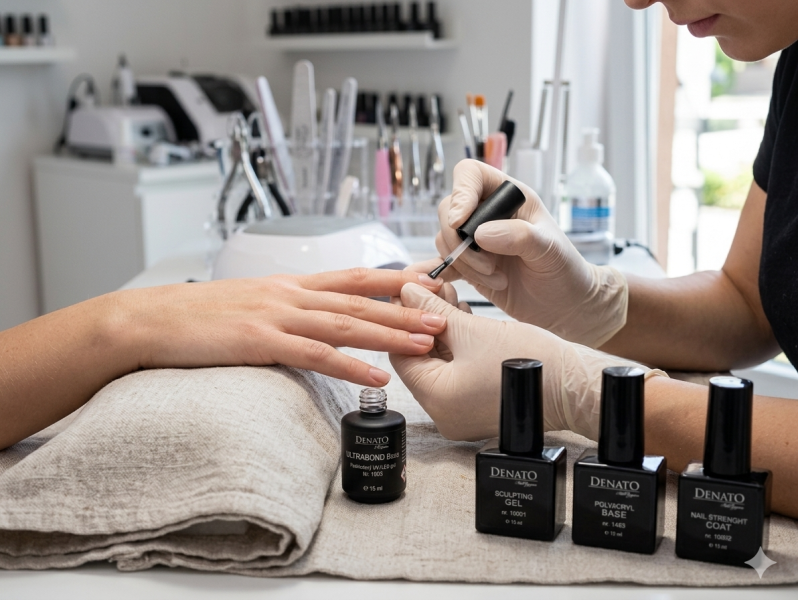
Base Gel: How to Choose the Right One?
Not all nails are the same. Each natural nail should be approached individually — according to its length, shape, working environment, and also according to the type of material we use.
Years of professional experience have shown one thing clearly: there is no universal solution. Every hand is different, every client has a different lifestyle, and different expectations regarding durability and comfort. That is exactly why choosing the right base is one of the key steps in the entire nail modelling process.
Let me walk you through a few insights I have written down based on many years of observation. Here you will find both a breakdown of adhesion liquids and an overview of our bases.
A correctly chosen base is not a detail. It is the foundation that determines adhesion, stability, flexibility, and the long-term reliability of the entire nail service.
Why There Is No Universal Base
One of the most common questions is:
“Which base should I use?”
The answer is simple — no base is universal.
Healthy, brittle, short, long, curved or flat nails all require a different approach. In the past, strength was often solved with tips, but today we mostly work on the natural nail. That places much higher demands on understanding materials and their properties.
If someone claims that one gel or one base is suitable for everyone, that simply does not reflect real salon practice. And I also cannot agree with the idea that an adhesion liquid is always necessary.
Myths About the Harmfulness of Nail Modelling
Nail modelling itself does not damage nails.
The deciding factors are:
- correct nail preparation
- properly selected material
- work technique
Damage most often occurs mechanically — through over-filing, an unsuitable combination of products, or incorrect manicure technique. The nail is not a tool and should always be treated with that respect.
There is also a certain influence from the internal condition of the body, but I will not go deeper into that here. You will be able to read more about it on my upcoming blog.
I personally do not wear natural nails, and from years of observation I believe that the shorter the nail, the more mechanical wear it experiences — and gel polish alone is not always enough. Women who wear longer nails may not be the favourites of physiotherapists, but mechanically they are often actually better off. In my opinion, after years of wearing longer nails, the hand automatically adjusts in the way it is used, so the person is less likely to injure herself. The nails are also used less as a tool.
Prep, Ultrabond and Primer – What Is the Difference?
When preparing the natural nail, we often work with several types of products, each with a different function. The correct combination helps improve adhesion and the overall stability of the modelling.
Prep (Dehydrator)
Prep is mainly used to degrease and dehydrate the natural nail.
Its role is to:
- remove natural oil from the nail plate
- reduce moisture in the surface layer of the nail
- prepare the surface for further adhesion products
Prep is used after mechanical nail preparation and before other adhesion products.
We offer it in three versions:
- Prep – bottle with brush
- Pre Nail Prep – spray
- Pre Nail Prep Scrub – spray with a liquid file effect
(Note: our pure Cleanser is an excellent liquid and also degreases the nail beautifully.)
Ultrabond (Liquid Bonder)
Ultrabond is an adhesion liquid that creates an adhesive layer between the natural nail and the material. In most cases, it works within a pH range close to the natural pH of a healthy nail.
It is used mainly:
- for problematic nails
- when material adhesion is reduced
- when working with harder modelling gels
It is important to let Ultrabond dry in the air completely so that a thin tacky layer can form. This is one of the most common mistakes even among experienced professionals, so pay close attention to it — it should be left to air dry for at least 30 seconds (ideally one minute).
EXTRA Primer
Primer has a similar function to bonder, but its effect is stronger. It is more acidic and therefore often rejected, but it definitely has its place.
It is used especially:
- for very problematic nails
- for clients with higher nail moisture
- when lifting occurs frequently
Primer improves the adhesion of the material to the natural nail, but it should be used very sparingly, ideally only in targeted spots.
- Extra primer – bottle with brush
- Primer pen – allows very precise quantity control
Ultrabond Gel
Ultrabond Gel is a base gel that works as an adhesion layer directly within gel modelling. I will describe it in more detail below.
Unlike liquid bonders, it:
- creates a thin gel adhesion layer
- polymerises in the lamp
- often replaces the use of liquid UB
Important Rule
You do not always need to use all products at the same time.
In many cases, it is enough to use:
Prep + a properly selected base or base gel.
Too many adhesion layers can sometimes create the opposite effect and actually reduce the adhesion of the material.
Personal Note
I often see that when adhesion problems appear, more and more products are added. In reality, the most common cause is usually insufficient nail preparation or a material that does not suit the specific nail type.
How Nail pH Works in Practice
The natural nail has a naturally slightly acidic environment, similar to the skin.
It is commonly stated that the pH is approximately 4.5–5.5.
If the nail is:
- damaged
- over-filed
- frequently exposed to chemicals
- or remains damp for a long time
its surface may become less stable and more moist, which can worsen material adhesion.
What does primer do in this case?
Primer (especially acidic primer) has several functions:
- removes residual moisture from the nail surface
- slightly etches the keratin surface
- creates a microporous structure into which the material can anchor more effectively
This improves both mechanical and chemical adhesion of the material.
In practice, people often say that primer lowers the nail’s pH. More technically, it would be more accurate to say:
- primer acidifies the nail surface and stabilises the environment for better material adhesion, but the pH of the nail plate itself is not something we would precisely measure or change long-term (similar to hair)
On the other hand, a heavily over-filed nail may hold material worse precisely because it is too dry and too smooth — not because it is “oily”.
That is why sometimes it paradoxically helps ONLY to:
- file less (USE PRE NAIL PREP SCRUB)
- or use a flexible base instead of an aggressive primer
It is therefore essential to work with what you actually see. Not every damaged nail will automatically respond well to the same adhesion liquid. Nail diagnosis is the foundation.
In practice, however, it also becomes clear that nail preparation alone is often not enough. The right choice of base plays a major role as well. And this is exactly where several repeated mistakes appear in salon practice.
Overview of DENATO Bases
Before introducing the individual bases, it is important to understand that their role is not limited to adhesion alone. A correctly selected base affects the flexibility of the entire modelling, its stability, and the long-term stress placed on the natural nail.
At Denato, we focus on making sure every base has clearly defined properties and purpose. Different nail types require different levels of flexibility, strength and adhesion.
Some bases are designed to strengthen the nail, while others are intended to absorb tension and movement. Since we now work with materials of varying hardness, we must think more deeply about preparatory bases as well.
Rubber Base
- two-phase, flexible bases
- available in several strength levels
- ideal for natural nails without extensions
- suitable for smoothing unevenness (for example spoon-shaped nails)
- removable with remover or acetone
- not suitable for extensions
- strength level varies from 1–5
With Rubber Base, it is important not to treat it as one universal product. Our bases come in different levels of strength, which is why each one includes its own firmness indication.
Flexibility of RUBBER Base gels:
- Clear: ***** (5/5) – the most flexible
- Cover Rosé: **** (4/5)
- Milky Rosé: *** (3/5)
- Cover Beige: ** (2/5)
- Milky White and Skinny: * (1/5) – the firmest
Selection recommendation:
- For firm nails – choose more flexible variants
- For soft and brittle nails – choose a firmer variant such as Skinny or consider strengthening with builder gels
- The individual bases can also be combined. For example, I recommend flexible Clear Base under firmer shades depending on the nail type, such as Milky White or the Skinny line, when a purely firmer variant alone is not the ideal match.
Ultrabond Base
- designed mainly for builder gels (Monophase, Master, etc.)
- ensures a stable connection between the natural nail and the modelling material
- there is no need to use additional adhesion liquids; use only Prep or PreNail Prep for disinfection and degreasing – when liquid UB is used, the material may pull away from the edges
This base works as a universal foundation for most modelling systems. If this option does not suit the nail, choose A.) a more flexible base or B.) a strengthening base.
Nail Strength Coat Nr. 10002
- thin strengthening base with vitamins
- suitable for weakened nails or nails exposed to moisture
- compatible with all Denato gels
This base connects the nail and the following builder material very effectively – it densifies the nail plate. Because it is based on a more acidic formula, I do not recommend balancing the nail pH further with UB liquid. I will explain why at the end.
Note: If you like our Crystal Clear gel (which is a flexible builder option) or Master Clear and the client does not do well with classic UB Base, then they most likely need a stronger foundation or a change to a firmer gel type.
Base/Top 2in1 Nr. 5700
- combines the function of base and top
- ideal for short, firm nails as a standalone base and top (in combination with gel polish)
- also suitable for pedicure under gel polish
- removable with remover
This base is not a modelling product, it only serves as a base layer. If you need to strengthen or level the nail plate, I recommend Rubber Base or a builder gel with the corresponding base. In a way, it is universal (meaning flexibility and strength are 50/50) – so it will suit firm, non-stressed nails well, but the strengthening effect will be average.
Consider whether this combination alone is enough for gel polish application. A clear sign that the nails are not suitable for this level of reinforcement is peeling from the free edge already after one week. In that case, the nail is too soft and needs more strength.
I will repeat it again: the IBX System densifies the nail plate enough that even this option can become suitable for most women.
Polygel Base Nr. 1493
- base primarily intended for use with polygels and power gels
- provides increased stability and strength under firm gels
- suitable for heavily stressed nails
- also suitable when working on a weak nail followed by a firm structure using a denser gel such as Master Cover
This base, just like Strength Base, has a more acidic foundation, so there is no reason to create a “cocktail” on the nail by adding UB liquid or other adhesion liquids.
Sculptural Gel Nr. 10001
- flexible base with the properties of a rubber gel
- high flexibility without cracking
- can be used on its own or under gel polish
- suitable wherever greater flexibility in the modelling needs to be preserved
- ideal as a connecting layer with Coffin tips (full cover tips). Why? Full cover tips are firm by nature and more or less replace a harder gel structure, so it makes sense to cushion the structure underneath
- removable with remover (including Coffin tips)
This base has solved lifting problems for many clients. Some modelling systems need cushioning, and in this case Sculptural is, in my experience, a very reliable solution.
Very soft / “paper-like” nail
Here it is often better to strengthen the nail first so that it can carry the modelling at all. I mention the IBX System again — in these cases it is an essential part of the process and can save you a lot of trouble.
- strengthening base / coat
- or a thin structure
Soft, but not extremely soft – the free edge bends when touched, yet still has enough flexibility
Here a flexible base that works together with the nail is often the better option.
- Rubber Base, Sculptural Base
- flexible foundation such as Crystal Clear (underneath it, UB liquid is enough if allowed to evaporate properly)
Save this:
SOFT NAIL → needs support
FIRM NAIL → needs flexibility
PROBLEM NAIL → needs stabilisation
3 Most Common Mistakes When Choosing a Base
Over the years, I have noticed that problems with lifting very often do not arise because of the gel itself, but because of an incorrectly chosen base.
I most often encounter these three situations:
1. Trying to Use One Base for All Nail Types
A very common mistake is trying to find one universal base that will work for every client.
But in practice we can clearly see that:
- a soft nail needs different support than a firm nail
- a short nail behaves differently from a long one
- a nail stressed by manual work behaves differently again
That is why it is always necessary to think in terms of the right balance between flexibility and firmness.
2. Too Many Adhesion Liquids
If the modelling does not hold, we often tend to add more products:
- Prep
- Ultrabond
- Primer
- another base
But sometimes it is precisely too many adhesion layers that create the opposite effect and make adhesion worse.
Very often it is enough to use:
Prep + the right base.
3. Mismatch Between the Base and the Builder Material
Another common problem arises when:
- a very flexible base is used
- and a very firm builder gel is placed on top of it — or the other way around
The materials then work differently, tension builds up, and the modelling may start to lift or crack.
That is why it is always worth thinking about the whole system as one unit that has to work together.
My Experience from the Salon
In practice, I often see that the problem with lifting is not the material itself, but the fact that the base does not correspond to the type of natural nail. Once the right combination of flexibility and firmness is selected, the stability of the modelling improves significantly.
Pinching
Why Work with Curvature and Pinching
The strength of a nail is not about the thickness of the material, but about its shape.
A correctly built curvature distributes pressure, absorbs impact, and significantly increases the durability of the modelling — even when working with a thinner layer of material. That is why today we can create natural-looking, fine, yet very durable nails without unnecessarily overloading the natural nail plate.
Modern techniques and tools help us a lot in this area. For example, working with dual forms makes it easier to understand correct structure and apex placement. But it is still important to realise that tips do not solve physics for us — we need to work with the material in a way that is efficient and does not cause harm.
If a base that is too soft is chosen, or if the correct base type for the particular nail is not identified, the resulting modelling can lose stability. The nail may then become overloaded, bend, or crack — not because of the technique itself, but because of the wrong material choice.
This is not about saying that older techniques are bad or outdated. The development of materials simply allows us to work differently today — more efficiently, more gently, and with a better understanding of nail biomechanics.
Today we know that the right combination of base, firm builder material, and shape is the key to long-term stability. And this is exactly where the real work of a professional begins.
Flexible vs. Firm Base in Relation to Curvature
Not every nail needs the same level of flexibility.
A flexible base follows the natural movement of thin, soft, or heavily stressed nails. But if it is used as the supporting layer in a modelling with a more pronounced curvature, it may bend too much under pressure and compromise the stability of the entire construction.
A firmer base, on the other hand, creates a stable foundation that holds its shape and supports a properly built apex. In techniques where we work with pinching or a more defined structure, this stability is crucial.
The key question is therefore not “Which base is better?”, but rather “Which base is suitable for this specific nail type and chosen technique?”
The right material choice combined with an understanding of shape means fewer repairs, fewer liftings, and above all less stress on the natural nail. That leads to satisfied clients and saves you time.
When to Be Careful with a Strong Curvature
Not every nail is suitable for strong pinching and a pronounced C-curve.
Caution is especially important with:
- very short nails without a free edge
- extremely flat or wide nail beds
- nails with damaged or weakened nail plates (here I recommend IBX)
- nails after trauma or repeated over-filing (again, IBX)
- clients whose nails are heavily mechanically stressed in everyday work
With a short nail without a free edge, the structure has no room to “work”, and trying too hard to force a curvature can create pressure on the nail bed.
With very flat nails, aggressive pinching can lead to uncomfortable tension or later lifting.
In these cases, it is often better to work with a gentle, functional modelling without excessive narrowing — with an emphasis on balance, not on an extreme shape.
Here, the goal should not be a trend, but respect for the anatomy of the nail.
Underside Refining
I often get asked whether it is necessary to refine the underside of the nail, so let us explain the benefits:
Why Refine the Underside of the Free Edge
1. Reducing Mechanical Pressure on the Modelling
The natural nail moves — it bends during everyday use of the hands.
If the underside of the free edge is too thick or uneven, a lever effect is created under pressure, which can cause:
- lifting of the modelling
- cracking of the material
- breaking off of the entire modelling
Refining the underside helps lighten the free edge and reduce mechanical stress.
2. Better Connection Between Material and the Natural Nail
On the underside there are often:
- old keratin layers
- uneven areas
- micro-chipping
Light underside refining cleans the lower edge of the nail so that the modelling can better follow the natural shape.
3. Creating the Correct Nail Architecture
For structured nails, the balance between the apex and the free edge is essential.
If the underside of the free edge is too thick:
- the centre of gravity shifts forward
- the modelling starts to behave like a lever
Refining the underside helps maintain correct structure and nail stability.
4. Preventing Material Lifting
Very often, lifting starts exactly at the free edge.
The reasons:
- the natural nail bends
- the material is firmer
- tension arises
Refining the underside helps minimise this tension between the material and the natural nail.
5. Aesthetics and Lightness of the Modelling
A refined free edge underneath:
- looks finer and more professional
- does not appear heavy, and thanks to the firm material still looks thin
- creates a more natural nail silhouette
This is especially important for:
- almond shapes
- ballerina shapes
- modern salon shapes
Important Notice
Underside refining must always be very gentle and controlled.
The goal is not to thin out the natural nail, but to:
- remove excess material
- lighten the free edge
- clean the lower edge of the nail
Today, the slimness of the nail is almost one of the most important aspects of a perfect modelling result.
If possible, I recommend coating the underside of the nail with a matte gel; on longer nails it looks very natural. Brilliant Gloss nr. 1484, on the other hand, leaves a glossy finish and also lasts until the refill.
Important
If the nail is shortened before modelling, underside refining is almost essential.
After shortening, a micro-edge often remains underneath, which can later cause lifting.
My recommendation — leave nail shortening until the very end.
Conclusion
Choosing the right base is the foundation of a successful nail modelling result.
It is not about having one “best” product, but about understanding the properties of the materials and knowing how to combine them according to the specific nail. I am also planning a blog article about builder gels.
Harmony between flexibility, firmness and aesthetics is the goal of every professional service. Whenever you are unsure, I strongly recommend IBX. It densifies the nail plate and makes the nail stronger. Then I would say that for most nails, a flexible base becomes a suitable option.
| Nail type | Recommendation |
|---|---|
| very soft / brittle | IBX + strengthening base |
| soft | Rubber Base Clear / Sculptural |
| normal | UB Base |
| firm | flexible base |
Why, for example, do I recommend UB Base for normal nails? Simply as a thinner adhesive layer when working with cover shades or denser monophase gels (in these cases it can sometimes be useful to work in a three-phase system).
Note
For easier orientation, you will find a small number in brackets next to each base. This number indicates the approximate pH value of the product and can help when choosing the right base according to the type of natural nail.
I have used this system for several years as a simple guide when working with different nail types and selecting materials. Now you are among the first who can use this small number in your own practice and achieve nails without lifting.
At the same time, it is always important to keep in mind that there is no universal solution — every nail is different and should always be approached individually. The number is only a small hint, but the most important thing will always be observation of the nail itself and practical experience.
FAQ: Practical Questions from Salon Practice
Do I always need to use Ultrabond or Primer?
No. In many cases, correct mechanical preparation, Prep and a properly selected base are enough. Too many adhesion layers can actually make the result worse.
How can I tell if the selected base is too soft or too firm?
If the system is not working in harmony with the type of natural nail and the following material, the modelling will begin to lift, crack, or place unnecessary stress on the nail. Watch how the nail behaves over time, not only immediately after the application.
When does it make sense to reach for the IBX System?
Mainly with very soft, brittle, damaged, or long-term problematic nails. The IBX System helps densify the nail plate and improves stability for further work.
Is Rubber Base suitable for every client?
No. Rubber Base comes in several firmness levels, and that is exactly where its strength lies. It must be selected according to the specific nail type, not simply because it is considered a “popular base”.
Is underside refining always necessary?
Not always, but in many cases it is very useful. Especially when shortening the nail before modelling, or when working with structured modelling where the balance between the apex and the free edge is crucial.
Article Author:
This article was prepared by the DENATO expert team based on experience from professional salon practice in collaboration with Lucie Králová.
Updated:
This article has been updated according to current knowledge and professional procedures in the nail modelling industry.